.jpg)
• Tokenization is not about market size; it is about rebuilding the infrastructure of how value moves through the real economy.
• When assets become programmable tokens, opaque markets built on guesswork pricing move toward continuous, real-time price discovery.
• Tokenized supply chains shift the system from fragile “just in time” logistics to transparent “just in sight” networks.
• Continuous data from tokenized assets turns supply chains from reactive crisis managers into predictive early-warning systems.
• If tokenizing is just about creating dashboards or tickers it will fail to reach its true potential. Imagining actual success helps us build for the future.
Most people talk about tokenization as if it's a magic wand that cuts margins, moves resources, and forges a more functional world. Most conversations about tokenization start and end with market capitalization.
Boston Consulting Group says the market for tokenization is $16 trillion. Standard Chartered says $30 trillion. The numbers are staggering, and they are also beside the point. Capital is the capacity for innovation, not innovation itself. Technology needs to solve problems and not make digits appear on spreadsheets.
Here's our question: what does a tokenized world actually do differently? Not what assets sit on a decentralized ledger, but what changes in the physical economy when the value layer underneath it becomes programmable, transparent, and continuous.
Tickers and dashboards are nice to have, but they're not the end game. We need to imagine what happens to supply chains, price discovery, and the trillion-dollar logistics systems that move goods from raw material to your front door. We need to have a theory of victory if we're going to win the race to 2030.
So, what does it actually look like?
The End of Guesswork Pricing
One of the least discussed and most transformative implications of asset tokenization is what it does to price discovery. In traditional markets, the price of an illiquid asset is whatever someone last paid for it, which might have been months or years ago. It could be a Rothko painting or a shipment of tomatoes; the market pays according to the agreed-upon terms.
Private equity, real estate, commodities in transit, warehouse inventory: these assets are priced through appraisals, estimates, and educated guesses. Sometimes the opacity is a bug that lets informed buyers know they're getting a steal on that painting. Other times, it's a feature that allows merchants to know the commodity they need to unload is squarely in a seller's market.
In the end, this is market inefficiency disguised as business as usual.
Tokenization changes the physics. When an asset exists as a programmable token with an auditable transaction history, its value becomes observable in something closer to real time. Not because the asset changed, but because the information asymmetry around it collapses. Middlemen of necessity can't take outsized cuts because buyers and sellers operate from the same data. Valuations update continuously rather than quarterly. Capital flows toward accurate pricing instead of away from uncertainty.
This is already playing out in the spreadsheet world of financial markets.
According to Accenture's 2026 banking analysis, 87% of financial institutions are now exploring tokenization as a tool to issue digital versions of traditional assets. Major firms rarely onboard new tech out of novelty. The network that has the most effect is the one which wins the day.
When Siemens deployed decentralized ledger-based treasury infrastructure through its banking partners, the company reported a 50% reduction in bank accounts, 80% automation of cash application, and more than $20 million in annual savings. This is a multinational corporation demonstrating what happens when money moves with precision instead of friction. Efficiency wins.
Now, extend that logic from financial instruments to physical goods.
Smart Logistics and the Death of "Just in Time"
The just-in-time production model was one of the great triumphs of 20th-century manufacturing. It was also a bet that the world would remain predictable. COVID broke that bet. Tariff volatility reinforced the lesson. According to the 2025 McKinsey supply chain risk survey, 82% of organizations reported that new tariffs directly affected their supply chains, with nearly 40% seeing increases in supplier and material costs.
Swiss Re estimates that supply chain disruptions now cost organizations approximately $184 billion annually. The system designed for efficiency has become a system optimized for fragility. Fortunately, a pivot is happening.
The conventional response has been to shift from "just in time" to "just in case," meaning more buffer inventory, more warehousing, more capital tied up in goods sitting on shelves as insurance against the next shock. It is expensive, and it is reactive.
Moreover, it replaces one asymmetry of information with another. It provides monopoly power with the capital for stocking shelves for rapid deployment. Tokenization offers a third path: just in sight.
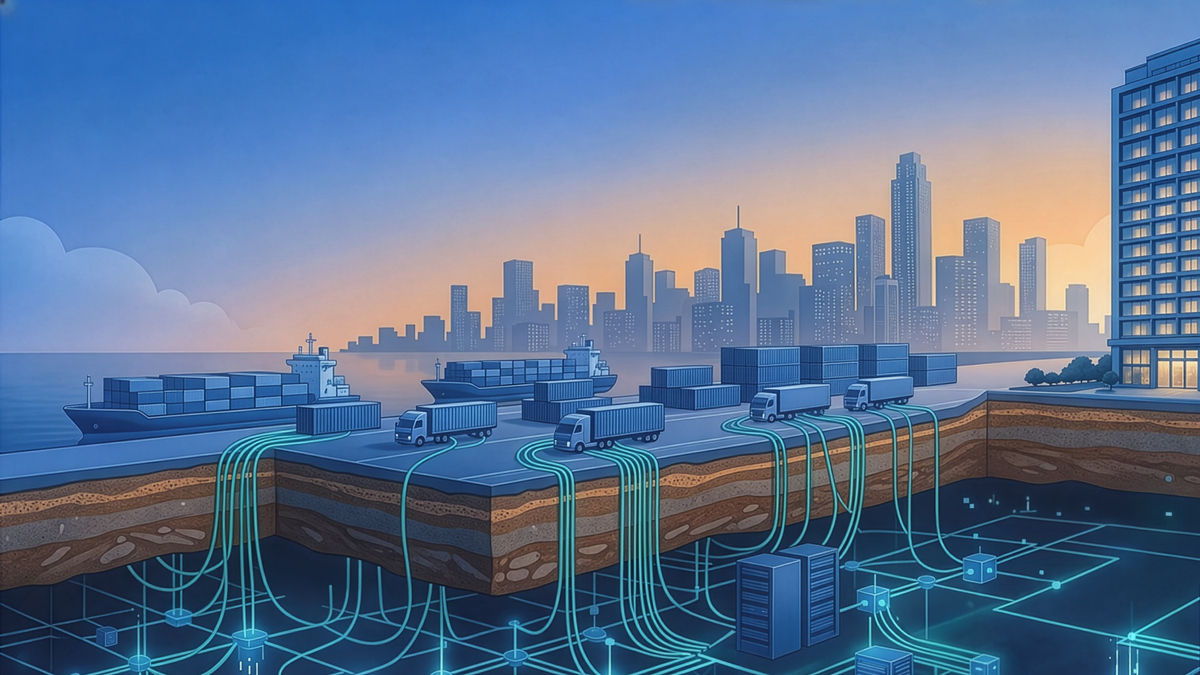
When physical goods, shipping containers, warehouse inventory, bills of lading, and certificates of origin are represented as programmable tokens on a shared ledger, the entire supply chain becomes observable. Not after the fact, through reconciliation and audits, but continuously. A tokenized shipping container does not just tell you where it is. It tells every stakeholder in the chain what it is worth, what its insurance status is, whether its contents have been exposed to conditions outside specification, and whether the payment terms attached to it have been met.
Again, large firms are taking the lead. BMW Group recently executed its first fully automated, pre-programmed foreign exchange transaction using tokenized deposits, automating the entire FX lifecycle through conditional logic: balance checks, auto-deposits, and real-time currency conversion, all executing within minutes and outside traditional banking hours.
This single transaction demonstrates what becomes possible when money is programmable. Now imagine that same logic applied not just to treasury operations but to every node in a supply chain. What happens when this is not merely a single transaction?
From Reactive Recovery to Predictive Resilience
The compounding effect of tokenized supply chains is foresight. When every asset, every shipment, and every payment in a logistics network generates continuous, auditable data, the network itself becomes an early warning system.
Consider what this means during a disruption. Today, when a port closes or a tariff shifts overnight, companies spend days or weeks tracing the impact through their supply chains. A 2025 McKinsey report estimates that the global logistics and transport sector alone requires $36 trillion in infrastructure investment by 2040 simply to keep pace with current demand.
This fragile network is unsustainable and the information systems which undergird it were designed to manage it were built for a less volatile world.
A tokenized logistics network does not eliminate disruptions. Weather still happens. Geopolitical fractures happen. But it compresses the time between a disruption occurring and every affected party understanding its implications. When the value, location, ownership, and contractual status of every asset in a network is visible in real time, rerouting is not a weeks-long exercise in phone calls and spreadsheets. It is a data-driven decision made in hours.
J.P. Morgan projects that the value of transactions processed through real-time payment systems will increase by 289% between 2023 and 2030. Deloitte's 2026 payments outlook estimates that remittance fees remain above 6% globally. Digital currencies are projected to process up to $13 trillion in transaction value by the end of this decade. These are the green tips of an infrastructure shift in which value moves at the speed of information rather than the speed of paperwork and middlemen.

The Infrastructure Layer Nobody Talks About
The market projections, the $16 trillion to $30 trillion by 2030, assume that the infrastructure gets built. Moving speculative assets has been done and produced little or no value. They were called NFTs and pictures of bored apes may have bought a couple mansions but they didn't build them. However they proved some important things.
Interoperability between decentralized networks works. Compliance frameworks can cross borders. That the settlement layer connecting tokenized assets, tokenized deposits, and traditional banking rails becomes reliable enough for institutional use at scale. So now, things must be built. To do that, the world needs a common picture.
The Bank for International Settlements has identified four architectural models for achieving this, ranging from fragmented individual platforms to fully integrated common settlement systems backed by tokenized central bank reserves. Currently, most of the industry sits at level one: fragmented. The winners in this space will not be the organizations that tokenize the most assets. They will be the ones that solve the connective tissue between those assets, between chains, between regulatory regimes, and between the physical and financial worlds.
That is the real race. Not to $30 trillion. To the infrastructure that makes $30 trillion possible. So we know these things are possible. We know that they can happen at scale in the digital world. This is the beginning of the race, not the end of it. The ticker is a scoreboard that gives us a common set of facts.
What matters is what gets built underneath it. What matters is efficiency at scale. What matters is the foresight to create a robust system rather than a fragile one. Stay tuned for the next blog where we'll take a look at what happens if we stay in a fragile world of fractured information.